Contents
This week in selective computation
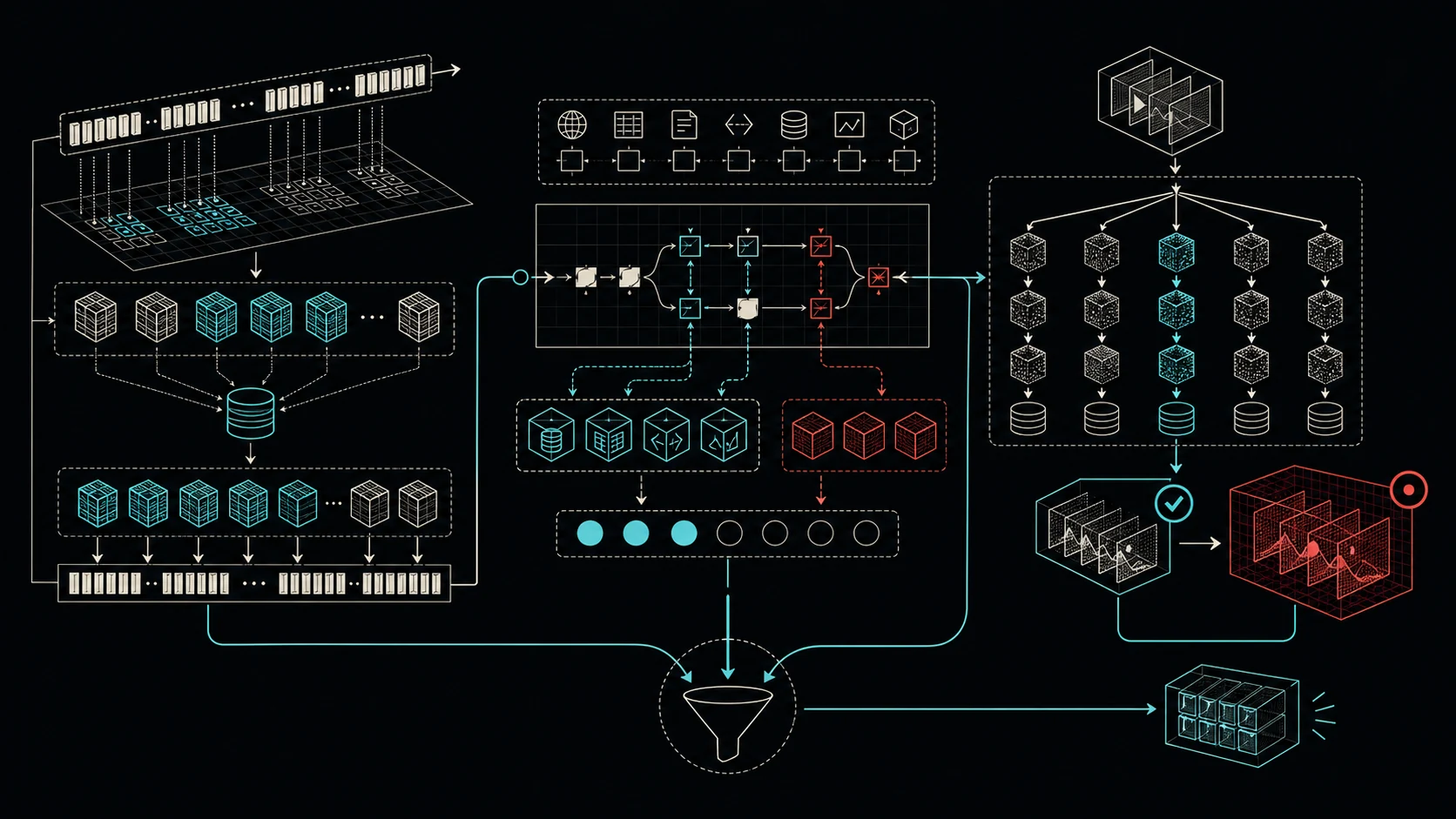
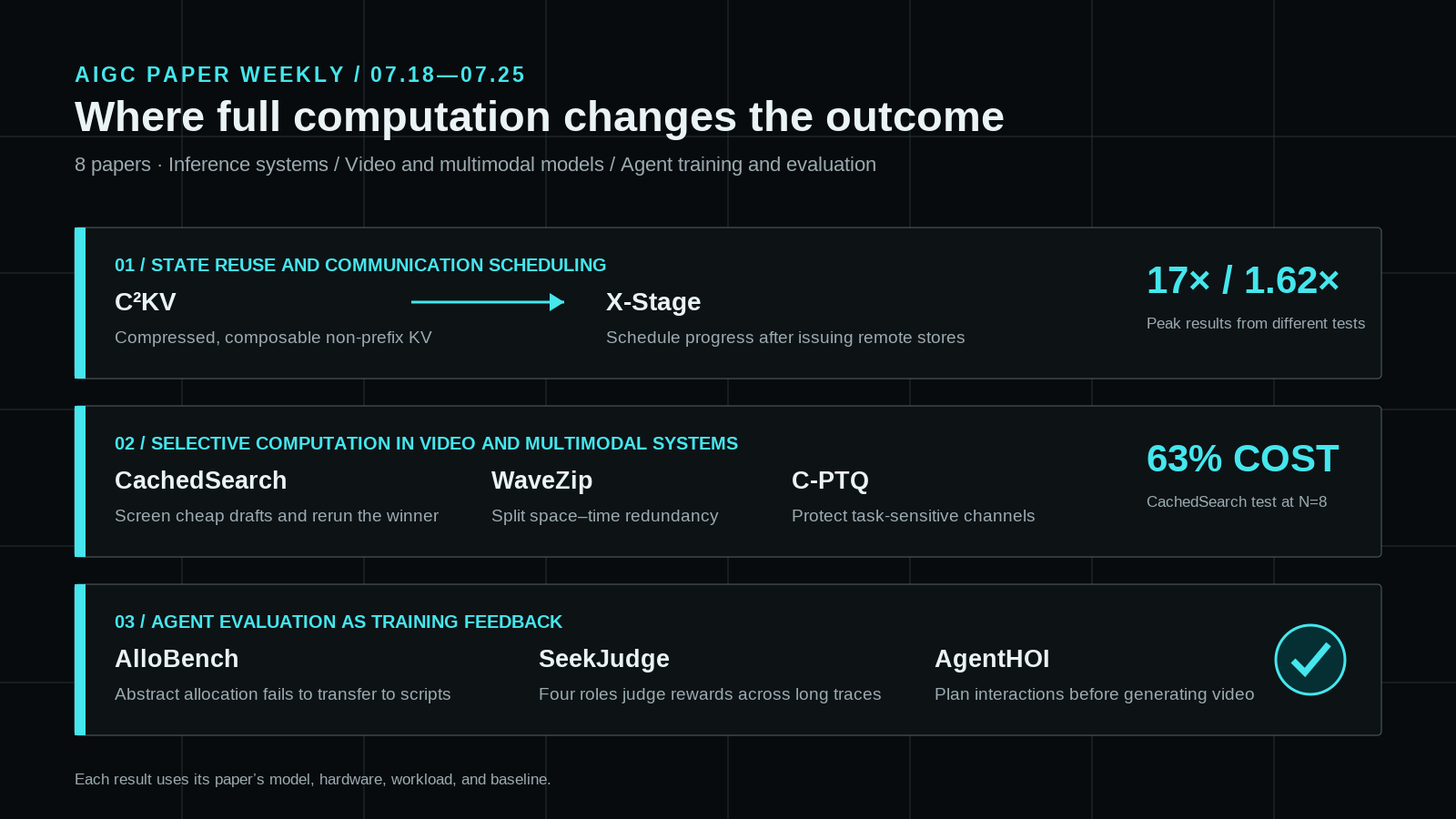
The papers from July 18–25 ask when a full computation is needed. Long-context inference reuses compressed model state. Video generation screens inexpensive candidates and fully denoises only the winner. Long-video understanding uses frequency to decide which frames and details to keep. Agents have to decide which actions are worth turning into reusable tools.
These papers cover generative AI, inference systems, multimodal models, and agents. The performance figures are author-reported under each paper's models, hardware, data, and baselines.
Which computation should run?
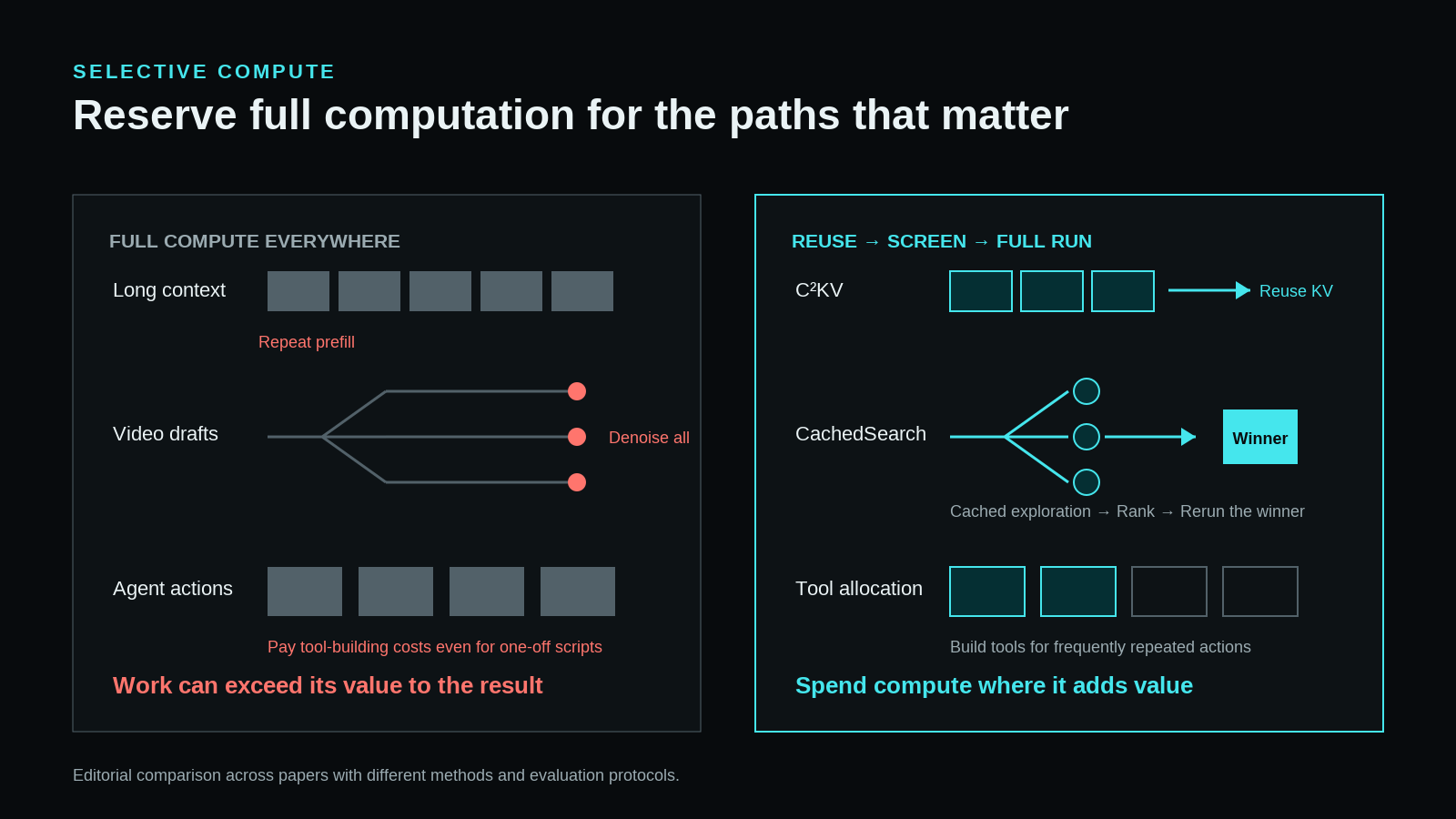
A fast kernel reduces the cost of a given operation. Several papers ask whether that operation needs to run in the first place. Long contexts may avoid repeated prefill, video candidates may avoid full generation, and video tokens may receive unequal budgets. Reusable agent tools can save repeated work when they repay their upfront creation cost.
The common design is to construct a cheap proxy and reserve full computation for a few high-value paths. The proxy must also preserve the ranking or decision that full computation would have produced.
LLM inference and reusable state
C²KV composes compressed caches from non-prefix documents
C²KV addresses reuse in retrieval-augmented generation and multidocument inference. A traditional prefix cache struggles to reuse a processed document when its order or position changes. Directly concatenating document caches can hurt quality because positions and contexts no longer match.
A lightweight Extractor runs beside the frozen base model. Learned compression tokens and structured attention extract independently storable, position-independent representations from each context segment. Training rewards both information retention and the base model's ability to consume multiple concatenated segments. The resulting units can be reordered and combined as documents change.
The authors report lower KV storage and transfer costs while maintaining generation quality across several long-context tasks and models, with up to 17× inference speedup in a particular setting. A production evaluation would include the Extractor cost, cache hit rate, inter-GPU transfers, concurrent scheduling, and fallback when a stored representation fails to match.
X-Stage exposes post-issue progress in remote stores
X-Stage tracks what happens after a distributed diffusion transformer kernel issues a remote store and before that data becomes visible at the destination. A short burst can drain while computation continues. Sustained injection can fill outstanding capacity and stall subsequent issues. The Burst-Gap model describes backpressure-free issue time, effective drain rate, and outstanding capacity.
On an eight-GPU node based on a recent NVIDIA architecture, the modified DeepGEMM MegaMoE kernel shows a 1.18× geometric-mean speedup across 84 configurations and up to 1.62× versus the Expert-Wave baseline. In Ulysses sequence-parallel attention, the authors fuse tile-granular post-attention All-to-All with FlashAttention and report peak sender-visible speedups of 1.43× and 1.42×. Those measurements cover kernels and sender-visible time. Service throughput also depends on work outside those intervals.
Video search, video tokens, and multimodal quantization
CachedSearch screens cheap video candidates first
CachedSearch speeds up best-of-N video generation. Aggressive caching produces approximate candidates for a verifier to rank, and only the winner is regenerated with full computation.
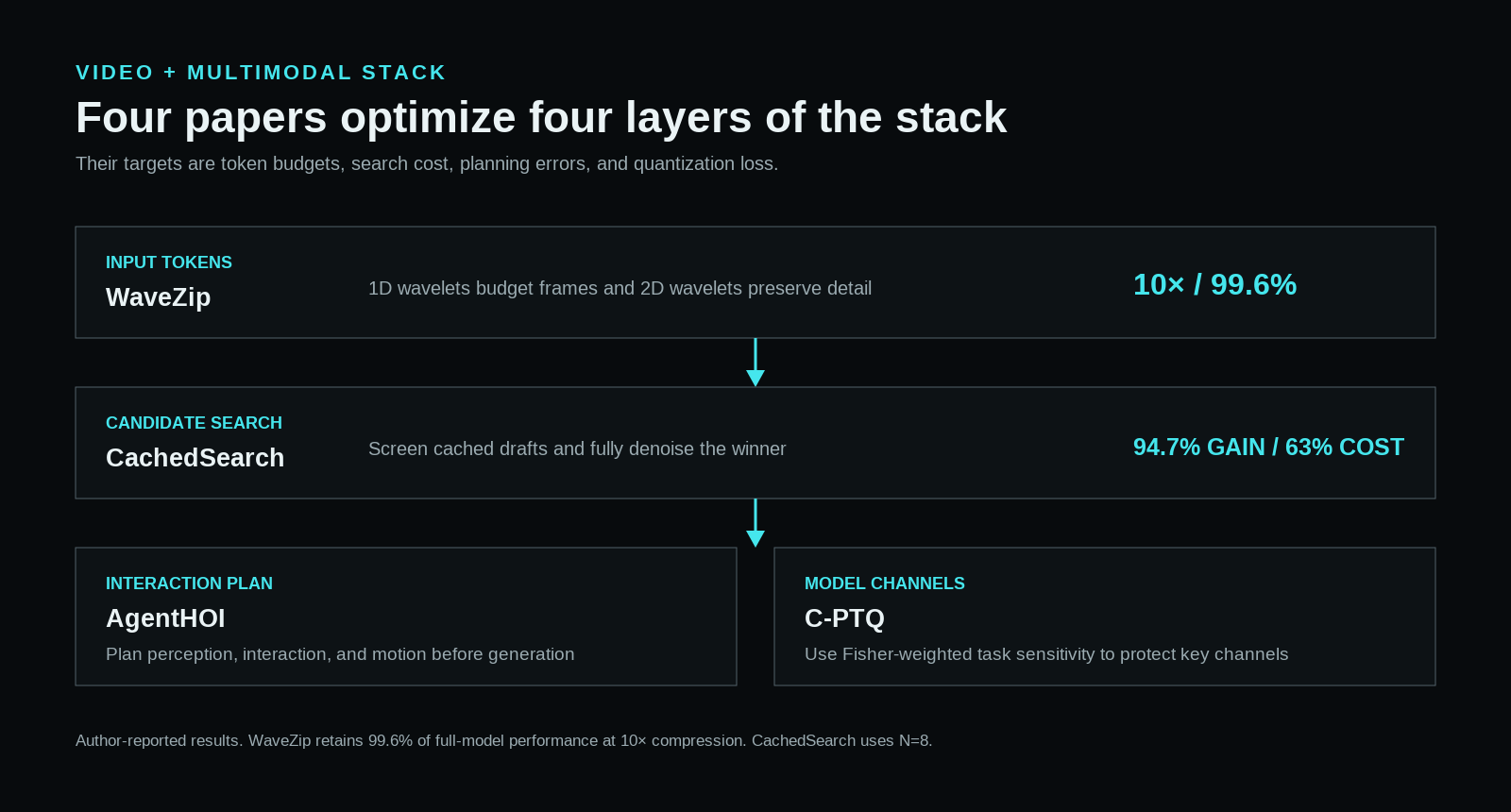
On Wan2.1-T2V-1.3B, the authors report a per-prompt median Spearman rank correlation of 0.905 between cached and full runs, with 72% top-1 agreement. Fully regenerating the selected candidate recovers 90–94% of the full-search benefit. At N=8, CachedSearch delivers 94.7% of the best-of-N benefit at 63% of the cost. Experiments span models from 1.3B to 14B across Wan, LTX, CogVideoX, and Hunyuan. One parameter needs recalibration across model families, and close candidates can still swap ranks.
WaveZip budgets temporal redundancy and spatial detail independently
WaveZip reduces visual tokens in long-video vision–language models without task-specific training. A 1D discrete wavelet transform over time combines high-frequency coefficients, interframe differences, and query relevance to assign frame-level budgets. A 2D spatial transform separates coarse structure from fine detail and emphasizes high frequencies in query-relevant regions.
Across the paper's long-video understanding benchmarks, 10× token compression retains 99.6% of full-model performance. OCR, fine-grained actions, and brief events warrant separate checks because their evidence can be easy to discard.
C-PTQ protects channels that matter to the task
C-PTQ uses a Fisher-weighted objective to approximate how each channel's quantization error affects task loss. Token-level or modality-level statistics can measure an outlier's size while missing its effect on the task. The authors test weight-only and weight–activation quantization on eight benchmarks using Qwen2.5-VL, InternVL2, and LLaVA-OV, without adding LoRA modules.
A tight quantization budget can then go to channels where error changes the task result. Fisher estimates depend on the calibration set and tasks. Check their stability when moving to OCR, video, or a different domain.
Agents and the cost of tool creation and judgment
AlloBench tests tool creation as an online allocation problem
AlloBench assigns an upfront cost to building a reusable tool. Later calls must save enough work to repay it. The benchmark pairs abstract descriptions of this decision with executable script-building tasks. Claude Haiku, Claude Opus, GPT-5.4-mini, and GPT-5.6 Sol are close to optimal on the abstract tasks yet fail to transfer the strategy to script allocation. Training Qwen on abstract allocation generalizes to changes in wording without improving the executable setting. Text-only plans and actual tool creation can therefore reveal different resource behavior.
SeekJudge makes evidence in long trajectories searchable
SeekJudge addresses rewards for computer-use agents. Rules can break as applications or online content change. Asking a large proprietary model to read a complete trajectory is expensive at scale.
Four roles, Condense, Ground, Seek, and Analyze, share a seed-calibrated distilled 9B backbone. A Seek–Analyze loop finds relevant evidence before returning a judgment. The paper measures reward quality through downstream success on held-out reinforcement learning objectives. Its learned reward matches or exceeds native rule supervision in the tested environments and supplies step-level judgments. Application changes and safety boundaries outside those tests still require validation.
Taken together, AlloBench and SeekJudge isolate two engineering decisions. Before execution, the agent decides whether a tool is worth building. After execution, the reward system finds enough evidence in the trajectory to train on it.
Planning human–object interactions before video generation
AgentHOI targets videos of actions such as wearing or riding, where the model must track object state, contact, order, and motion constraints. Multiple roles perform perception, interaction reasoning, and motion planning. Implicit text–motion alignment distills a text-to-motion prior into the video diffusion model. During inference, the textual plan guides generation without an explicit extra motion input.
The authors report stronger naturalness, object appearance preservation, and complex instruction following than their baselines. Rare objects, sustained contact, and occlusion still need targeted physical and temporal evaluation.
What to watch next
- C²KV turns context prefill into a modular asset that can be compressed and composed.
- CachedSearch assigns different costs to exploration and final generation.
- WaveZip and C-PTQ allocate compression budgets according to frequency structure or task loss.
- AlloBench tests the economics of agent-created tools, and SeekJudge turns trajectory judgment into a reward service.
Production quality hinges on recoverable failure paths. Measure cache mismatches and fallbacks, the loss from ranking errors, what token removal destroys, and whether incorrect rewards get amplified by training.
Paper links and figure credits
AIGCage prepared this issue from the public papers, method diagrams, and experiments. All performance figures come from the authors. A generative model produced the cover, and AIGCage redrew the research map and mechanism diagrams.